Showing posts with label Advertising. Show all posts

Friday, 31 July 2015

Oasis and the New Honesty Marketing Campaign

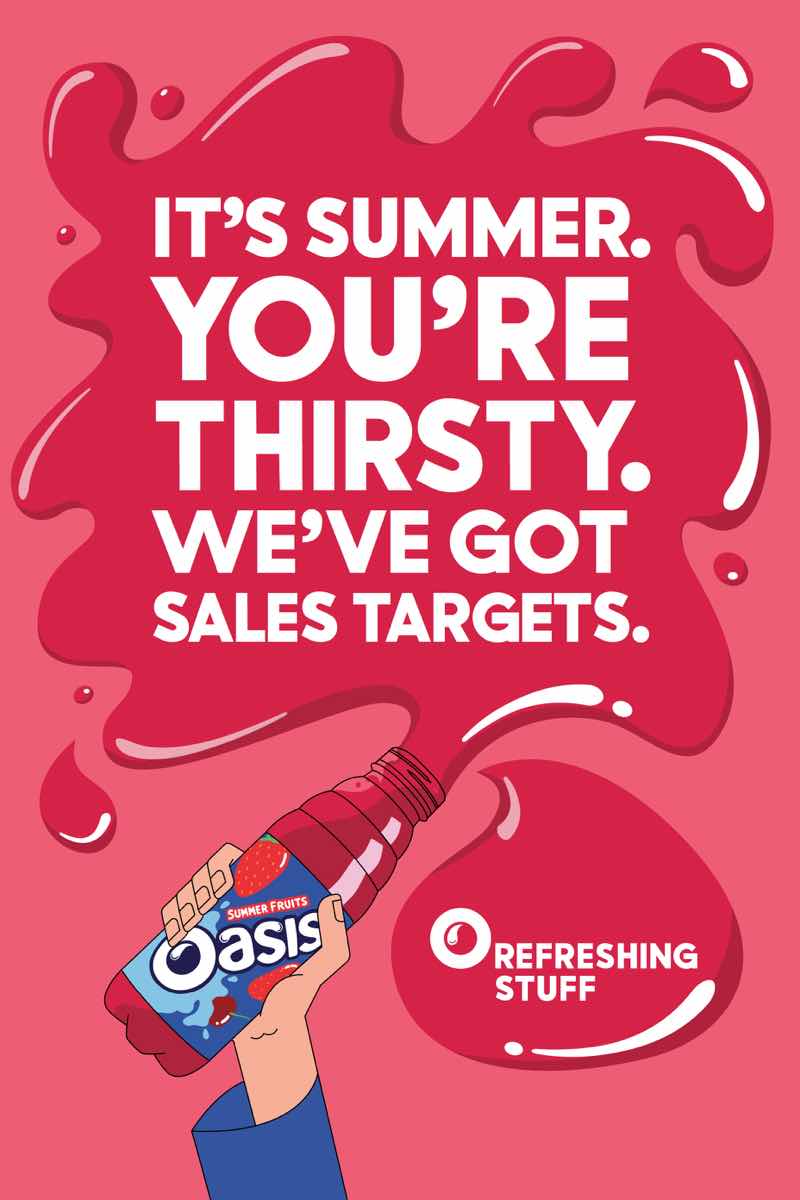
I've been amused lately by the new Oasis campaign. If you haven't seen any of the latest campaign, the main tagline is "It's Summer.  You're thirsty. We've got sales targets".

Honesty Marketing at it's finest
Well, do they say honesty is the best policy, but is it likely to work?

The history of Oasis is a little muddled.  It was originally launched in 1966 by Volvic under the name 'Pulse', but poor sales led to its rebrand as 'Oasis' in 1990.  Its history then gets a little complicated, but in essence it was acquired by the then Cadburys-Schweppes who launched it into the UK in 1995. It was then acquired by Coca Cola Enterprises in 2005 along with a number of other European drinks brands.

Oasis has been positioning itself as a "healthier soft drink" solidly for 20 something adults who are happy to pay premium prices for a relatively standard purchase - in this case, squash from concentrate. By suggesting itself as an alternative to water rather than something like Coke, it links the brand to healthy options and positions itself firmly in the health category.

They also have access to a lot of the Coca Cola distribution network; if somewhere sells Coke, they are likely to sell Oasis and include it in their deals.

There were product problems that needed fixing when CCE acquired it: Oasis used to have a heavy sugar content which meant it failed originally as a healthy option.  This was eventually sorted by reconfiguring the recipes, but there were several false starts on the way with low calorie versions such as 'Fusion', 'Lights' and 'Extra Lights' which, despite over £3m launch spend in marketing, were withdrawn quickly afterwards due to bad sales.

So far, so good.

However, Oasis does have a problem in that it's never quite seemed to manage to fix its brand image
The ill-fated and pulled Cactus Kid campaign
in a clear and coherent fashion, despite obvious heavy investment from CCE. Numerous advertising campaigns have been and gone with varying levels of success and memorability.  Do you remember the "Chug it?" adverts, the first after CCE took over?  They pretty much sank without a trace, so it's not that likely.  Or the 'Cactus Kid' campaign the year after, which had a wide multi-media approach including adverts, videos, websites and a whole fake mythos, which was abruptly pulled after complaints to the ASA that it encouraged children to drink Oasis instead of water?  There have been more, but all fairly without impact.

Still, CCE isn't going to abandon Oasis to its fate.  The global soft drinks business is falling as people look for healthier options; soda consumption globally is now equivalent to what it was in 1986 having been falling steadily since 2005.  In additional, Coca Cola has been targeted specifically by health groups such as the CSPI in Amercia (the Center for Science in the Public Health) partly due to its high profile and market share.  To counterbalance, CCE has been adding non-soda companies to its portfolio in the last 7 years to try and diversify their risk, including investing in 5 smaller companies and buying 3 more.  It owns companies like Glaceau (who make SmartWater), Fuze tea, Zico coconut water and Honest Organic tea.  Even the flagship brand itself is feeling the pressure by releasing new formulations such as Coke Life which replaces sugar with sevia, although this still hasn't been launched in the US to date.

Oasis, as a brand in the right place at the right time is a potential goldmine, if they can just get the right messaging.

The latest campaign has been created by 'The Corner' agency, and have gone into what is called 'insane honesty marketing' and 'humanised marketing' (thanks to Cuco Creative for the terms and some of the info in the next couple of paragraphs). It's a big change from some of the glitz and style that they've delivered previously.

This shift is designed to appeal to millennials; i.e. people who reached adulthood around 2000, so will now be in their 30s and who value transparency and honesty in the communications from big brands rather than slick presentations. So Oasis are changing their emphasis slightly from 20s to 30s: not something they would do lightly and without a lot of consumer research. The Pioneers of this sort of thing were companies like Innocent with their smoothies and vegetable pots. It's also notable in companies that actively engage in social media, especially those that have a distinct personality and human voice.

The ultimate payoff of this strategy is trust: if a brand is willing (or at least seen as being willing) to be open about their weaknesses, then when they talk about their strengths, the listener is far more likely to believe them.  It's a known phenomenon known as the Halo Effect.

The likelihood is that this campaign will be more successful than their previous ones, and this time they are looking at a segment with more disposable income and more health-consciousness.  They are also more likely to have children, and so be under more social pressure to provide healthy options for lunches and outings. My guess is that the next push is likely to focus on health benefits, which will be more believed than previous claims after this initial bout of honesty.  So my feeling is that yes, it will work, as long as they can maintain whatever claims they make and continue with the human messaging.

I'll be interested to see how it goes!


Wednesday, 11 March 2015

Cellulite, Palm Oil and Orang-utans? Why Social Media and Over-Regulation Doesn’t Mix

Nutella, the famous Italian chocolate spread and chocolate sweets manufacturer is currently in a lot of PR hot water in France at the moment.  It’s an amazing example of how not only to completely cock-up your social media campaign, but to actually damage your brand as well. 

The concept of their "Say it with Nutella" campaign was pretty simple.  Nutella decided that for PR purposes, they would make a small web-based application where you could type in your name, and it would display a picture of a Nutella pot with your name on instead of the brand name.  You could then post it all over the web to your heart’s content, secure in the knowledge that everyone would know how much you love the chocolate and hazelnut goodness.  This had already been done in Italy with great success.  
A gif containing a set of some banned
words thanks to Rue 89.  Apologies
to the easily offended souls out there!

Of course, when you release something into the wild, you have to accept that a small minority of people are going to try and subvert it.  Just think of the Nike ID campaign where you could get your name embroidered onto your trainers: an MIT Student caused Nike huge amounts of negative publicity by asking for 'sweatshop' instead of a name, and went public with the back and forth emails when Nike refused.  And as a rule, the internet is far worse for this.  Nutella seem to have been aware of the danger, and took steps to protect themselves.  Thus people who tried type in something not entirely wholesome got a 'this word is not allowed' message.  Except, more and more people kept experiencing this, way above what would normally be expected, and some really weird words seemed to be banned.

At which point, someone technologically savvy went into the code to investigate what was restricted.  With a little bit of ingenuity, they managed to pull the full list of blocked words.  From my perspective, there were four groups:

  1. Obscenities: this is actually relatively morally defensible as a majority of Nutella’s key audience are probably under 18 or buying on behalf of children who have access to social media.
  2. Trademarks, such as 'Coca Cola' or 'Microsoft': again, reasonable on legal grounds because theoretically Nutella could be seen in breach of copyright should the images be spread on social media.
  3. Words which could be theoretically be used to contravene the French laws on hate speech, especially the 1990 Gayssot Act, which includes a five year fine for holocaust denial, and criminal penalties for defamation based on race, gender, ethnicity, sexual orientation or any handicap .  For Nutella this meant banning words such as 'Hitler', 'Muslim', 'Judaism' and 'Lesbian' (but not 'gay' strangely).  Whilst the fact you can't put 'Jew' onto a image of Nutella jar has been picked up by the British media and decried as evidence of discrimination, it is almost a direct lift from the legislation and is defensible, if ill-judged. 
  4. And finally, what can only be dubbed as the “Oh God we hope no-one brings these up” topics, and include things like ‘obesity’, ‘fat’, ‘palm oil’, and ‘orang-utan’.  And this is the major cock-up because you cannot justify censorship based on paranoia of your own working practices.  Nutella have listed and blocked every topic where they feel vulnerable, and these exact topics have been distributed all over social media.  It’s like the classic joke when someone tells you not to think about elephants and suddenly all you can think about are grey pachyderms, except this herd is going to stomp all over your brand equity.  
So now on social media, there are a lot of questions.  Why is Nutella so worried about palm oil?  What are they doing over in Borneo/Indonesia?  Are they deliberately destroying rainforest areas for their plantations?  Is it more likely to cause obesity than other chocolate spreads?  To make the situation worse for the company, the current French internet game of the month seems to be to try and get around the restrictions.  Maybe you can’t do Orang-utan, but what about Oran-gutan?  Or Oranutan?  And once people manage a work around, they post it proudly on social media, reinforcing the message and linking Nutella obesity and rainforest destruction as well as more swear words than you can count.  

The problem for Nutella is that the internet is a realm of looser of societal rules.  Whilst no-one would consider breaking into an office to rifle through a computer to look at concept artwork for a campaign, anything on the internet is seen as fair game.  You can’t put restrictions on anything beyond the bare minimum because whatever you do will be publicly scrutinised so has to be defensible, and there are a lot of people out there better at programming than your average corporate web department.    

This fiasco illustrates some very basic rules of online marketing:
  • If you are going to use something, you need to have a basic understanding the technology and its limitations.  I'm pretty sure that had Nutella realised that it was even possible to get the full list, they wouldn't have done it. 
  • Expect anything interactive you put onto the web to be potentially subverted by a small minority and don’t panic when it happens.
  • Keep a level of perspective.  So what if a couple of people write ‘Obesity’ on an image and post it on Facebook?  It would be gone from most people’s feeds in an hour and be forgotten.    
  • There is a skill in dealing with ‘hecklers’ with a modicum of grace: if you can do so, generally these things are over quickly and don’t affect your core audience.  In other words, keep your cool.  One or two images with a comment on palm oil aren't going to put off your standard consumer.  Sadly, people have a level of unconscious blindness over things they don’t want to see when it involves giving up something they want: see things like Climate Change vs car use, or the demand for meat over conditions in battery farms.    
  • And the cardinal rule: if you can’t defend something, don’t put it on the internet.
In the almost-words of the infamous 1980s TV advert; “Ah, Mr Ambassador, you are really spoiling the jungle with your Orang-utan murdering, obesity-causing treat!”.