Showing posts with label Communication. Show all posts

Tuesday, 4 April 2017

Social Media (Part II)

It's an old image but a good one
You looked at the last post. You worked out the basics of your social media, looked at your audiences, understood your resources, and nailed down what you want to achieve and sorted out what sort of voice you want to have. Excellent!

Now you need to do is choose which social media channels you want to use that will compliment that. So what do they all do? How are they different? And isn't it all about Facebook anyway?

This is a very basic overview on some of the most recognised services (Facebook, YouTube, Instagram, Twitter, Snapchat and LinkedIn) to help you get some ideas, but with any sort of investment, further research is definitely recommended, especially if the habits of your identified audience does not match any of the channels listed below.

Additionally, this is very biased towards Europe: for example YouTube, Facebook, Twitter, Google and more are all banned in China, so localisation of your strategy is super important!

Facebook

Facebook is without question the biggest and most active social network on the web, both in terms of name recognition and total number of users.

With nearly 1.8 billion active users, and over a billion people using Facebook daily, it's a good medium to reach a large number of people. The spread is fairly wide, with users throughout age ranges (often topping more than 70% in various countries) with a bias towards female-identified users.

It's also versatile with pages, groups, and targeted advertising, with it's strength is in its business to consumer reach. Facebook can be used to share photos, videos, important company updates and more, allowing for a wide ranging relationship. It's excellent for community building in many forms and bringing customers together. Advertising can be tied to demographics and locations, and is very good for local sales and brand awareness. Additionally, the site can be more low-maintenance than other social networks as it has a lower expected posting frequency than something like Twitter, and with the business features enabling scheduled posts it means you can be a little less tied to the pages, and people will scroll backwards on your page to look at prior entries.

YouTube

YouTube is the second largest online search engine after Google, has over a billion active users per month, and is heavily used as a resource for how-to content. The largest demographic of users is 25-34 year olds and 45% of users have some form of higher education.

If your customers and audience are asking questions, YouTube gives you the chance to provide unique, personality-filled answers to these questions and problems.

To use this, you must have the resources to have a good video editor. Whilst some companies choose not to, moderation of comments is a must. You can also engage via vloggers (video bloggers) who have dedicated channels with subscribed audiences, although they must always declare they have been sponsored and you are likely to need to pay depending on your industry.

Instagram 

Instagram is owned by Facebook, and is a visual social media platform based entirely on photo and video posts, and has nearly 400 million active users per month. It's all about the images, and offers easy-to-digest and aesthetically pleasing content. Images tend to be aspirational: beautiful images of travel, fashion, good food and such like, but there are images across the board. Companywise, if what is being sold can be visualised in an appealing way, this could be a good channel.

So who uses it? Well, Instagram has a bias towards a younger demographic with more than half it's users under the age of 30 with an equal gender split. More than 80 million photos are shared daily on instagram, and the platform, like snapchat, is almost entirely mobile. Instagram has a passionate community and has one of the highest engagement rates for brands, 58 times higher than on Facebook; however, it can be hard to find a niche. Company messaging needs to be heavily visual, and social media managers need to be good at photography and video editing.

Twitter

Twitter allows the sharing of short updates of 140 characters or fewer (ideally no more than 120 to allow for retweet handles) along with other media such as pictures, videos, URL links etc. By mentioning usernames in your posts, you can get the attention of other users and is one of the easiest ways to connect. It has around 319 million active monthly users, around 23% of internet users, and is slanted towards a more male-identified user group.

Twitter is effective for getting out news in a clear, concise fashion, skipping over the delays in press releases and other more traditional media, and is used as a resource by journalists. It creates a feeling of immediacy and access to a wide range of stakeholders, including knowing exactly what industry experts are looking into hour by hour, new developments, and can be a useful tool for handling customer service. Content is easily shared through retweeting, and creating the right tweet with the right hashtags can result in going viral very quickly. Along with LinkedIn, Twitter is one of the most professional/B2B focused channels.

It's worth being aware that Twitter is one of the most time sensitive mediums after snapchat. As Twitter moves so quickly, tweets tend to get lost quickly, so it's not the place for beautifully crafted content, and timing can be key to reaching a target audience. It also requires a quick response time: if a complaint comes via Twitter it needs to be at least moved onto private messages within a few hours, or face potential escalation. It is most easily handled through the use of apps like Hootsuite, allowing scheduling and easier searching.

Snapchat

Snapchat is another visual social media network which can only be used on mobile devices. It has 150 million active users, with 71% of are under 34 and around 70% are female. Whilst this has a large gender and age bias, in the UK more than 25% of smartphone users have snapchat installed. Users can send videos and photos to one another (which are deleted after 10 seconds), or post content to their public Stories, which disappears after 24 hours. As posts are so temporary, content is accepted to be a little more rough and ready than some other networks. Stories can be useful, but only users who have added a business can see their content.

Snapchat is excellent to create story and interactive content with a specified and engaged audience in a less formal setting, especially as the app includes chat features, messaging and other media content. 


LinkedIn

Whilst LinkedIn started as a professional networking site, it is now a knowledge and information-sharing hub. It has more than 35 million active users per month, has an older slant age range than most social media with the biggest demographic just being between 30-49, with the 50-64 age range just behind and is slanted more towards male-identified users. Users have the highest education level of all sites, and generally the highest incomes.

It allows professionals to showcase expertise, publicise awards, form professional communities, give business updates to relevant and interested audiences as well as network. LinkedIn via it's blog functionality has the best opportunity of enabling companies to become thought leaders through original content, and users tend to spend longer per page than in many other sites. It also provides a repository of information about a company and is a standard port of call for anyone doing any sort of research. However, it's worth being aware that it has one of the lowest engagement rates of any social media: simply put, users won't click a like for the sake of it, so adjust your expectations accordingly.

Of all the social media, LinkedIn is the most focused on business to business and professional in tone: this is most certainly not the place to put up pictures of your cat unless you work in some sort of animal health industry.

*

There are of course, many other channels, but this is a place to get started. And when looking at which channels you wish to engage with, always remember that it's better to focus on one or two channels, than try and cover a gamut and get overwhelmed.

Have fun out there!

Tuesday, 7 March 2017

On Social Media (Part I)

I recently finished a 12-month contract for a medical publishers, which was interesting and probably deserves several posts of its own, but in the meantime I am currently in the process of sorting out another position. In a recent interview, there was a question on social media and which channels they should be using.

Who let all these guys in here?
Whilst there are an ever-increasing number of options, there are a number of core platforms that have managed to maintain users and market share, and it’s choosing between these that can cause grief.

So how do you know which ones you should be using? Well, it's a combination of a number of things and there's no one good answer because different channels have different pros and cons.

Before you start to register your name on YouTube or Facebook, you need to ask yourself these questions:

  1. What do you want to achieve? This is obvious, but are you looking at improving customer care, or are you trying to make a way for people to place complaints? Are you trying to create a way to keep people up to date with your company and products? Do you want to encourage conversation or build relationships? Do you want to establish yourself as an authority? Each one of those aims leads to a slightly different media channel.
  2. Do you meet an unmet need for your target group? Whatever your aim is, as with any digital project you should aim to meet an unmet digital need to give people a reason to look at your social media, even if that is to give a good communication channel to your potential customers.
  3. Where do your target audiences go? If you know who your target audience are, try and identify where they already go to. People are creatures of habit, and it’s much easier to hijack off an existing habit than make them go to somewhere different. Perhaps Instagram would be perfect for your goals and targets, but if your target market all use snapchat, then go there. Hunt where your targets roam!
  4. Your available resource (staff): Doing any sort of social media takes a lot of resource in terms of time. You are looking at a minimum of three and a half hours per week: half an hour per day with an extra half hour on Monday and Friday to initially plan the week and assess how the posts went at the end for each channel. Additionally, the higher the interaction and speed of reply needed, the more your staff need to have flexibility be able to respond to social media, so the staff cost goes up. Additionally, you need to consider where your staff are physically: responding can be more difficult if they are field-based rather than desk-based, and how will you manage holiday cover? What do you have the staff resource to do?
  5. Your available resource (Money): YouTube is a fantastic channel, but unless you are doing videos on your smartphone or have basic recording equipment in your office, videos (both animated and film) will cost you money to produce. Similar with high quality photography. You need to be aware of ongoing costs in the channel/s you choose.
  6. Frequency: How much do you have to say? Do you have exciting news every day that you want to convey? Are you mainly reposting existing articles/videos/opinions? Some channels need more new content than others and you need to bear that in mind.
  7. Company fit: Some channels are more formal, and some are more informal. This can be tweaked, but if you have a couple of options it’s worth trying to use one more in keeping with the ‘tone’ of the content and the vision you have for your communication. 
  8. Industry fit: Are you in a highly-regulated industry? Do you need all marketing collateral to have regulatory approval? Does your company culture like to check all communications before they are sent out into the wider world? The stricter the controls you are under, the slower the channel you want on social media. You can get away with a 24 hour turn around on Linked-In, but that’s not going to fly on Twitter where more than an hour could spell the difference between a PR success or a disaster.

Once you have a clear idea of your aims, your targets with their habits, your available resource and how you want to be perceived, you then need to pick your channels.

As this post is already getting fairly long, more on the channels themselves in Social Media (Part II).

Friday, 31 July 2015

Oasis and the New Honesty Marketing Campaign

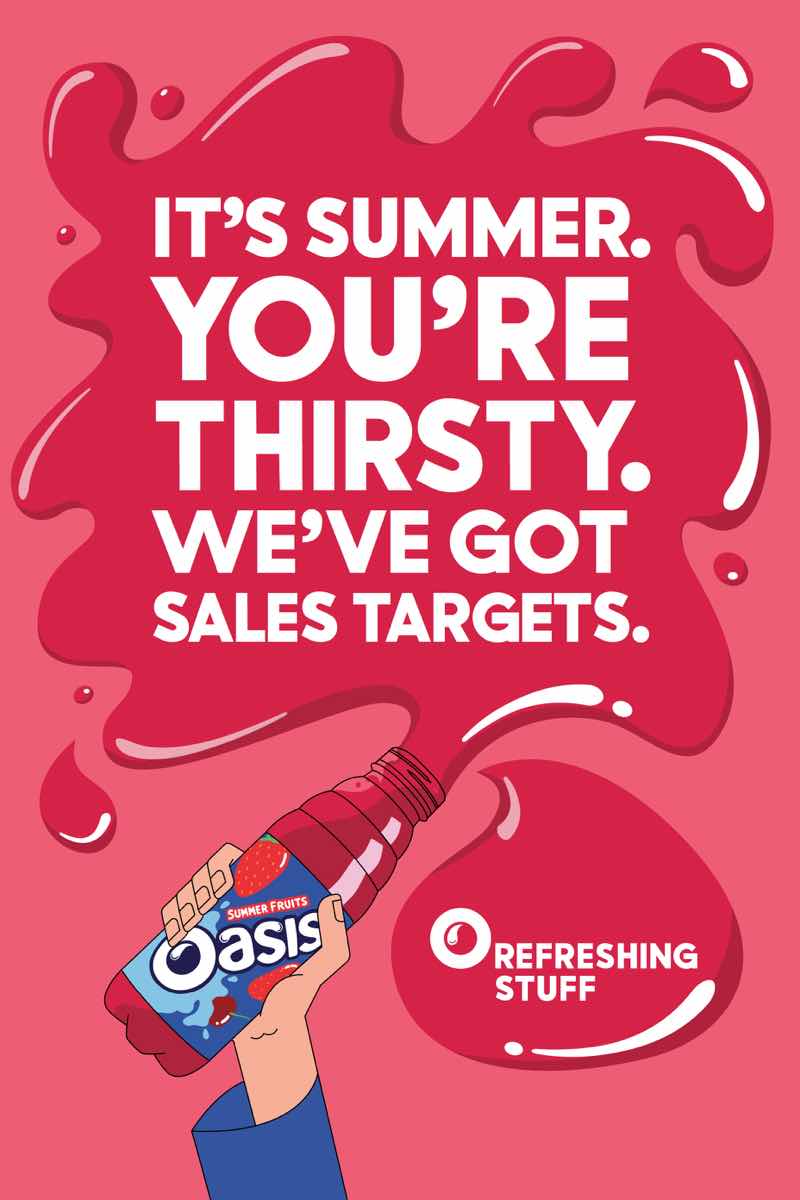
I've been amused lately by the new Oasis campaign. If you haven't seen any of the latest campaign, the main tagline is "It's Summer.  You're thirsty. We've got sales targets".

Honesty Marketing at it's finest
Well, do they say honesty is the best policy, but is it likely to work?

The history of Oasis is a little muddled.  It was originally launched in 1966 by Volvic under the name 'Pulse', but poor sales led to its rebrand as 'Oasis' in 1990.  Its history then gets a little complicated, but in essence it was acquired by the then Cadburys-Schweppes who launched it into the UK in 1995. It was then acquired by Coca Cola Enterprises in 2005 along with a number of other European drinks brands.

Oasis has been positioning itself as a "healthier soft drink" solidly for 20 something adults who are happy to pay premium prices for a relatively standard purchase - in this case, squash from concentrate. By suggesting itself as an alternative to water rather than something like Coke, it links the brand to healthy options and positions itself firmly in the health category.

They also have access to a lot of the Coca Cola distribution network; if somewhere sells Coke, they are likely to sell Oasis and include it in their deals.

There were product problems that needed fixing when CCE acquired it: Oasis used to have a heavy sugar content which meant it failed originally as a healthy option.  This was eventually sorted by reconfiguring the recipes, but there were several false starts on the way with low calorie versions such as 'Fusion', 'Lights' and 'Extra Lights' which, despite over £3m launch spend in marketing, were withdrawn quickly afterwards due to bad sales.

So far, so good.

However, Oasis does have a problem in that it's never quite seemed to manage to fix its brand image
The ill-fated and pulled Cactus Kid campaign
in a clear and coherent fashion, despite obvious heavy investment from CCE. Numerous advertising campaigns have been and gone with varying levels of success and memorability.  Do you remember the "Chug it?" adverts, the first after CCE took over?  They pretty much sank without a trace, so it's not that likely.  Or the 'Cactus Kid' campaign the year after, which had a wide multi-media approach including adverts, videos, websites and a whole fake mythos, which was abruptly pulled after complaints to the ASA that it encouraged children to drink Oasis instead of water?  There have been more, but all fairly without impact.

Still, CCE isn't going to abandon Oasis to its fate.  The global soft drinks business is falling as people look for healthier options; soda consumption globally is now equivalent to what it was in 1986 having been falling steadily since 2005.  In additional, Coca Cola has been targeted specifically by health groups such as the CSPI in Amercia (the Center for Science in the Public Health) partly due to its high profile and market share.  To counterbalance, CCE has been adding non-soda companies to its portfolio in the last 7 years to try and diversify their risk, including investing in 5 smaller companies and buying 3 more.  It owns companies like Glaceau (who make SmartWater), Fuze tea, Zico coconut water and Honest Organic tea.  Even the flagship brand itself is feeling the pressure by releasing new formulations such as Coke Life which replaces sugar with sevia, although this still hasn't been launched in the US to date.

Oasis, as a brand in the right place at the right time is a potential goldmine, if they can just get the right messaging.

The latest campaign has been created by 'The Corner' agency, and have gone into what is called 'insane honesty marketing' and 'humanised marketing' (thanks to Cuco Creative for the terms and some of the info in the next couple of paragraphs). It's a big change from some of the glitz and style that they've delivered previously.

This shift is designed to appeal to millennials; i.e. people who reached adulthood around 2000, so will now be in their 30s and who value transparency and honesty in the communications from big brands rather than slick presentations. So Oasis are changing their emphasis slightly from 20s to 30s: not something they would do lightly and without a lot of consumer research. The Pioneers of this sort of thing were companies like Innocent with their smoothies and vegetable pots. It's also notable in companies that actively engage in social media, especially those that have a distinct personality and human voice.

The ultimate payoff of this strategy is trust: if a brand is willing (or at least seen as being willing) to be open about their weaknesses, then when they talk about their strengths, the listener is far more likely to believe them.  It's a known phenomenon known as the Halo Effect.

The likelihood is that this campaign will be more successful than their previous ones, and this time they are looking at a segment with more disposable income and more health-consciousness.  They are also more likely to have children, and so be under more social pressure to provide healthy options for lunches and outings. My guess is that the next push is likely to focus on health benefits, which will be more believed than previous claims after this initial bout of honesty.  So my feeling is that yes, it will work, as long as they can maintain whatever claims they make and continue with the human messaging.

I'll be interested to see how it goes!


Wednesday, 22 July 2015

On Awards and the Importance of Localisation

Last month, the UK Team won an Internal Marketing Award (First Runner-Up) for a campaign that I ran at the end of last year.

Presenting the elevator pitch of the relevant UK
Campaign at the Awards Dinner.  There was a black and white
theme: I don't usually dress in monochrome!
It was an interesting process.  Each of our corporate offices were allowed to enter up to two marketing projects which we felt were particularly noteworthy from the last calendar year.  Submissions had to include information on strategic relevance, target markets, implementation, ROI (both qualitative and quantitative) and anything else particularly relevant.  Each marketing team in each country reviewed the circulated submissions and ranked them based on a number of specified criteria, a little like the Eurovision Song Contest.

The idea is for the global business to exhibit some of the best ideas with the aim of consideration for implementation elsewhere, as well as to give a level of recognition for the efforts involved over the past year.

The very different approaches showcased the unique properties of each country's markets.  I suspect this was also reflected in the scoring as well as different countries will have scored partly based on personal experience, and that in many cases the same project could have wildly differing marks.

Looking at the different projects and assessing whether or not we could use them in our own markets highlighted one of the key considerations in any global company: the importance of localisation.  Many of the projects were extremely good, yet would not be applicable in the current form to other territories.

Often, large global companies will create campaigns to be used in their subsidiaries.  This is important as it ensures brand continuity, clear consistent messaging and cuts down on the work needed on a local level.  However, no campaign should ever just be adopted without a level of analysis and evaluation for appropriateness against the target audience.  Culture, habits, phrases, communication and channels will all need to be checked.  In top down campaigns, localisation is often perceived as a threat to the brand; a dilution which causes damage.  However, without the flexibility to localise, most campaigns are dead in the water.  Brands need to be able to be recognisable whilst still meeting the different needs of the segments they are trying to reach.    

Badly localised adverts are common, especially on television.  Beyond bad dubbing and using obviously non-local locations, there can be inherent cultural issues.  Proctor & Gamble, who are generally fairly savvy, got it very wrong when they used an American advert in Japan which showed a husband walking in on his wife bathing and touching her.  Whilst in the US this was seen as sweet and a depiction of married intimacy, in Japan it was viewed as an invasion of privacy and was felt to be in very poor taste, depicting a bad marriage due to the lack of respect being demonstrated.

Communication channels too can be overlooked: a basic issue for any global social media campaign is that both Facebook and Twitter are currently banned in China, and have been since 2009.  Many countries have bans on blanket emails, and opt-in/opt-out countries will have very different approaches to e-Blasts and electronic CRM communications.

Translation/phrasing blunders can happen, and even within the same language localisation can be needed: for example US/UK spelling varies, and extraneous 'u's can be the difference between someone engaging or disengaging on a piece of text.

If you know your segmentation and your targets (your ST of the STP mantra), your campaign has to fit them in all aspects.  And using the indigenous marketing personnel is one of the best ways to do so.

And on that note, I'm off to go and put the Award Certificate somewhere!

Wednesday, 22 April 2015

Why You Should Bother With PR

For various reasons lately, I have been in discussions about the use of Public Relations within a company.


PR is an interesting area. It's dogged by a relatively poor reputation outside of its own industry: if marketing is "The Poster-Making Department", then PR is the "IT Girls and Champagne Thursday Slackers". Even if PR is seen as effective, then the broad stereotype is one of a 'charm and smarm' offensive via networking with the 'old boys' out of reach of mere mortals.

One of the biggest issues I've found is that PR Agencies are a little like Italian restaurants: it's it's rare to get a bad one, very easy to get a mediocre one, but quite tough to get an outstanding one, and unfortunately, until you've had a good experience, you don't know what you're missing. Which means that many companies have employed PR agencies due to not having the expertise in house and have been disillusioned by uninteresting results, tainting their view on the whole exercise.

According to Wikipedia, Public Relations is all about managing the flow of information between a company or an individual to the public. This is a pretty broad and consequently not that useful.  Personally, I think that The Chartered Institute of Public Relations' definition is more punchy. Paraphrased, PR is all about reputation: the result of what you do, what you say and what others say about you. The goal is earning understanding and support, and influencing opinion and [buying] behaviour.

But surely that's just marketing?

Well, yes, communication does come under the remit of marketing, and PR is part of the marketing tool kit. And every marketing campaign should have a communications plan.  But beyond that, PR has a very different scope and skill set to a more traditional marketing campaign.

Marketing is by it's nature is targeted to specific, limited segments. Audiences are categorised by multiple parameters, with the intent of creating messages that will appeal.  One of the first rules of marketing is that you can't be all things to all people.  Every day, marketeers have to make calls on 'Opportunity Cost' of their limited budgets - a term economists use for the next best thing you sacrifice.  In the same way that if you buy a new phone the opportunity cost might be a television upgrade, every marketing campaign you run to one audience is another one you can't create for someone else.  This is where ROI (Return on Investment) calculations often come into their own.  Brutally put, will my company get more money if I do option 1 or option 2?

Communication/PR works in the other direction.  It is much wider and aims to talk to as many of your business stakeholders as possible; often ones which have less of an immediate ROI but still have a say or influence.  It's using as many channels as possible to get the widest range of messages out there.  Whilst marketing funnels messages down the key people, PR is there to widen the net and aid your potential growth in the longer term.

PR has other advantages too: due to getting the right information to the right contacts, mentions of products, people or services are often seen as more credible coming from a third party.  It builds trust, and allows stakeholders to feel more engaged with you and the various audiences.  It speaks very much to a brand's image if the language and messages are consistent that fixes it without needing advertising.  It's also usually cheaper: whilst there is a people/time resource cost, press releases, phone calls, contacts and social media management are often free or low cost.

So if it's so great, why isn't everyone doing it?

Well, the main downside of PR is hard to measure.  Ultimately it is there to help communicate messages, and unless you do mass market surveys, you can't always tell if your attempts have been successful.  Looking at increases in sales over a PR campaign duration will always be hit by confounding factors, and even the actual measurables on something like social media (clicks, likes, shares, views and so on) only goes so far, and falls short of a convincing argument in a boardroom.  It can be difficult to get someone good to do the PR, and assigning it to the marketing assistant or the cheapest local agency without thought as 'it's just press releases' is a sure-fire way for it to fail.  All of this means that it can be hard to justify a spend on an agency or on an in-house PR person when you cannot see an immediate result or have gotten bad results in the past.

Plus, sometimes you do just need the money elsewhere.  PR is always one of the first cuts in any budget rationalisation.

In the end, it all comes down to personal judgement on questions like:

  • Where are your audience and do they already buy from you?  
  • Do you need to start developing different segments in the market and seeding ideas before going into a marketing push? 
  • How clear are your messages in the market place? 
  • What is your brand awareness? 
  • Are there key audiences you simply don't have the time to engage with? 
  • Can I measure at least some Key Performance Indicators (KPIs) for success?
  • Can you defend the choice to use PR to the senior management?
  • And most important: what is the opportunity cost of PR for the company?

It's not an easy choice, despite my pro-PR stance here, because it will always be hard to defend even with analysis and ROI calculations, and can leave you personally exposed.  At the same time, sometimes you just have to put your money where your mouth is.  Wish me luck!

Wednesday, 4 March 2015

Augmented Reality: Viable Channel or Virtual Pipe Dream?

Last week I went to a breakfast presentation by one of our suppliers.  It’s a nice thing to do occasionally, especially as it starts at 8.30am so you get into work at a reasonable time.  They showcase some of their new handy services and their customers get free croissants, coffee and networking opportunities.  This one was on Augmented Reality.

Augmented reality (in marketing terms) is where you use technology to give a real life interaction/touch.  It usually involves an App and a Smartphone or equivalent where you scan something in real life with the camera on the phone, which then gives you additional options/interactions in the digital arena.  QR codes were a form of basic AR, as was Blippar. These generally took you to an additional website or video with more information.  Blippar was slightly more advanced in that it offered 3D images overlaid onto camera images, but was confusing as no-one ever really knew what they could scan.

AR has moved on since then, and now is a lot more interactive.  It’s also starting to get embedded
The IKEA App promotional images
into standard media so you don’t need things like special codes.  One of the best examples is the current IKEA catalogue.  Firstly, you download a free App of the app store, and get a paper catalogue as well.  If you then hold your smartphone over an image of the product in the paper catalogue, it will create a 3D rendering of that product on your phone screen, whilst allowing the camera on the phone to show whatever you are looking at even when you move away from the catalogue, and say, look at the room.  The product is then superimposed on the background.  The idea is that you can see exactly what the sofa you’ve picked will look like in the corner and if it matches your curtains.  

Red nose day is very much in on the action as well, assuming you have the Taggar App: if you scan the 2015 badges, you will unlock Harry Hill showcasing additional content including jokes, real time photo additions and games (you can see a video here: https://www.youtube.com/watch?v=4EdiH0i2-po).  

But you can do more than that, oh yes!  You can augment your business cards so that a little miniature avatar of yourself appears standing on the card doing a pre-filmed presentation (you do it on greenscreen) when your card is scanned.  You can run sneak previews of products when KOLs get certain ‘toys’ in the post or at KOL events (scan this engine, and see a 3D rendering of the new car due to be launched in 4 months).  You can embed games into postal mail, so that when a client opens a brochure, they can run their phone over the images and voilĂ , a game appears!  The possibilities are, as they say, endless.

Lots of the audience really bought into this, and were asking for more information, got really excited, and started uttering the classic buying signal that most sales people dribble over: "I have a project this would be perfect for!"  And yet, I couldn't join in.  It felt like I was alone on an island of cynicism, the Grinch in the room, because no matter how I thought about it, as a useful communication tool for my industry, it's just not going to work.  

What you are looking at isn't a shiny toy.  Instead you're changing people's habits: essentially, you're looking at a possible game change changer.  Due to that you have to consider:
  1. The Adoption Curve 
  2. The propensity of your target audience towards a new thing in this arena
  3. What are your targets' current habits?
  4. Does this fit with the image/brand you want to portray?

1. The Adoption Curve
The Adoption Curve
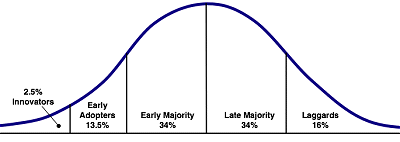
What is the Adoption Curve?  This is another of those Marketing 101's, and was mentioned in fair detail in the video in the last post.  What it demonstrates is that people do not take on new innovations or products at the same rate: important and because each group needs different messages and support within your campaigns.  

You'll notice that very few people buy into new things when they are first available.  Not everyone queues outside the Apple Store for that new iPhone; and how many people have an Apple TV?  Newness will appeal to less than 15% of your audience.  The rest want variants of reassurance, recommendations and solid proof of having seen the product in use.

And AR is definitely in the Early Adopter, if not Innovator phase.  You see that mass of people cowering behind the sofa from the scary new thing?  That's the rest of your target market who will never see your beautifully crafted AR content because by the time they are comfortable with it, it'll be out of date.

2.  The propensity of your target audience towards a new thing in this arena
It's also worth bearing in mind that people have different Adoption Curves for different areas.  If you're working for Apple, well, your key opinion leaders are going to be technological communication innovators anyway.  But you might find your surgeon who is willing to use the very latest surgical developments and tools can't programme the annoyingly spangley TV the kids demanded, or the environmentally conscious driver who insists on buying the newest hybrid car isn't fussed about the newest forms of social media.

Just because you sell new products in one area doesn't mean that your customers will be willing to adopt new methods of communication, and if you work in a more traditional, conservative industry you're going to hit that barrier twice as hard.  This is why you need to consider who your audience is, and what their preference is for communication.  Obviously, people are individuals, but certain personalities tend to be disproportionately drawn to certain industries: your average regulatory manager isn't going to be a wildly creative adrenaline junkie.  There's no point in making amazing materials if no-one ever sees them.  

3.  What are your targets' current habits?
So what does your target audience do? What are their communication habits?  And how similar is it to what you want them to do with Augmented reality?

How habits are formed: the reinforcing habit loop.
Habits are an evolutionary short-cut to cut down on the need to think and analyse every situation.   It takes around 60 days to form a new habit, and is a little like self-conditioning based around three stages: the cue, the behaviour and the reward.    One formed, habits get imprinted on your neural pathways and are incredibly hard to change.

Within marketing and PR, the most successful communication tools are those that complement what you already do because it's a habit.  So if your audience checks FaceBook every couple of hours, then working on social media is a good way to go.  If your audience always checks their physical post, then you're likely to use a postal mail campaign.  Does you audience watch a medical dramas?  Then put a TV advert into the middle of House (if you have the money).  It seems obvious, but you'd be surprised how many people forget this.

In order to use AR, you need to do a number of things outside of your normal habits:

  • Get the App: this is a barrier in itself as it involves going to the relevant App store, finding the right App, downloading it and working out how it works
  • Scan things using that App that you wouldn't normally scan like a business card and brochures etc.
You can already see the problem, can't you?  You're asking your customers to do complex processes which are totally outside the scope of their normal practice just to push a marketing message: to make a new habit.  Yet seeing marketing materials probably isn't enough of a 'reward' to be habit forming unless they get a real kick out of seeing something new and exciting (then the reward is linked to self esteem at being at being a pathsetter).  The only people that might are your "innovator" group in the adoption curve above, which is only about 2.5% of your audience.  This is why QR codes and Blippar failed: they didn't get people into the habit of using those apps by default, so when the audience did, it was a conscious effort, and easily ignored.  

I will add a coda that due to the nature of the adoption curve, the one exception is in the teenage market, because the very fact that most of the adults around the technology will not be interested or able to access it (due to having to get a new app) makes it instantly appealing.  But apart from that?  Not ideal for a mass market.

4.  Does this fit with the image/brand you want to portray?
Everything, ultimately, comes down to your brand and brand image in your communications, and this goes for channel/location as well as what's actually in it.  Want to be see as a family friendly drinks company?  Well, you're probably not going to give away samples in a strip club.  Want to be seen as eco-friendly?  You're probably going to use recycled paper if you do have to do a mailshot.

So if you want to be seen as technologically advanced or cutting edge, then yes, you could develop some AR materials as long as they came with huge rewards (such as prizes only winnable through the AR medium), as long as you did a lot of marketing on the side to get people to know it's there and how to access it.  But you're marketing the concept of AR and using it to boost your image rather than having it as an enhanced communication tool.  If it's for a more conservative industry?  I'd be wary. 


Overall, I like AR as a concept.  I think it's pretty cool as a toy and a way to stand out if you work and are pitching to a technologically innovative audience, or one who particularly like to feel like part of an elite sub-culture, but right now at this point in 2015 it's not ready for mass use as a standard communication tool.    

And, much as I like them, no amount of free coffee and croissants is going to convince me otherwise!