Showing posts with label Innovative Campaigns. Show all posts

Friday, 31 July 2015

Oasis and the New Honesty Marketing Campaign

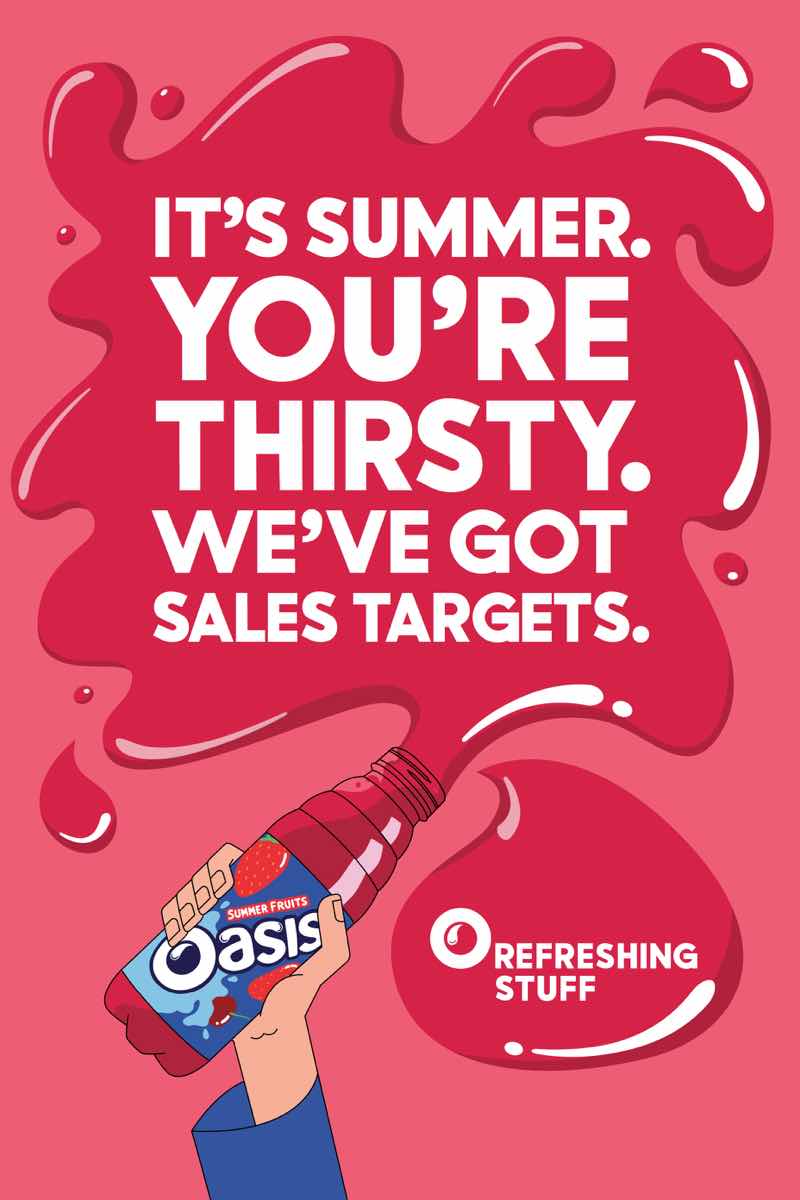
I've been amused lately by the new Oasis campaign. If you haven't seen any of the latest campaign, the main tagline is "It's Summer.  You're thirsty. We've got sales targets".

Honesty Marketing at it's finest
Well, do they say honesty is the best policy, but is it likely to work?

The history of Oasis is a little muddled.  It was originally launched in 1966 by Volvic under the name 'Pulse', but poor sales led to its rebrand as 'Oasis' in 1990.  Its history then gets a little complicated, but in essence it was acquired by the then Cadburys-Schweppes who launched it into the UK in 1995. It was then acquired by Coca Cola Enterprises in 2005 along with a number of other European drinks brands.

Oasis has been positioning itself as a "healthier soft drink" solidly for 20 something adults who are happy to pay premium prices for a relatively standard purchase - in this case, squash from concentrate. By suggesting itself as an alternative to water rather than something like Coke, it links the brand to healthy options and positions itself firmly in the health category.

They also have access to a lot of the Coca Cola distribution network; if somewhere sells Coke, they are likely to sell Oasis and include it in their deals.

There were product problems that needed fixing when CCE acquired it: Oasis used to have a heavy sugar content which meant it failed originally as a healthy option.  This was eventually sorted by reconfiguring the recipes, but there were several false starts on the way with low calorie versions such as 'Fusion', 'Lights' and 'Extra Lights' which, despite over £3m launch spend in marketing, were withdrawn quickly afterwards due to bad sales.

So far, so good.

However, Oasis does have a problem in that it's never quite seemed to manage to fix its brand image
The ill-fated and pulled Cactus Kid campaign
in a clear and coherent fashion, despite obvious heavy investment from CCE. Numerous advertising campaigns have been and gone with varying levels of success and memorability.  Do you remember the "Chug it?" adverts, the first after CCE took over?  They pretty much sank without a trace, so it's not that likely.  Or the 'Cactus Kid' campaign the year after, which had a wide multi-media approach including adverts, videos, websites and a whole fake mythos, which was abruptly pulled after complaints to the ASA that it encouraged children to drink Oasis instead of water?  There have been more, but all fairly without impact.

Still, CCE isn't going to abandon Oasis to its fate.  The global soft drinks business is falling as people look for healthier options; soda consumption globally is now equivalent to what it was in 1986 having been falling steadily since 2005.  In additional, Coca Cola has been targeted specifically by health groups such as the CSPI in Amercia (the Center for Science in the Public Health) partly due to its high profile and market share.  To counterbalance, CCE has been adding non-soda companies to its portfolio in the last 7 years to try and diversify their risk, including investing in 5 smaller companies and buying 3 more.  It owns companies like Glaceau (who make SmartWater), Fuze tea, Zico coconut water and Honest Organic tea.  Even the flagship brand itself is feeling the pressure by releasing new formulations such as Coke Life which replaces sugar with sevia, although this still hasn't been launched in the US to date.

Oasis, as a brand in the right place at the right time is a potential goldmine, if they can just get the right messaging.

The latest campaign has been created by 'The Corner' agency, and have gone into what is called 'insane honesty marketing' and 'humanised marketing' (thanks to Cuco Creative for the terms and some of the info in the next couple of paragraphs). It's a big change from some of the glitz and style that they've delivered previously.

This shift is designed to appeal to millennials; i.e. people who reached adulthood around 2000, so will now be in their 30s and who value transparency and honesty in the communications from big brands rather than slick presentations. So Oasis are changing their emphasis slightly from 20s to 30s: not something they would do lightly and without a lot of consumer research. The Pioneers of this sort of thing were companies like Innocent with their smoothies and vegetable pots. It's also notable in companies that actively engage in social media, especially those that have a distinct personality and human voice.

The ultimate payoff of this strategy is trust: if a brand is willing (or at least seen as being willing) to be open about their weaknesses, then when they talk about their strengths, the listener is far more likely to believe them.  It's a known phenomenon known as the Halo Effect.

The likelihood is that this campaign will be more successful than their previous ones, and this time they are looking at a segment with more disposable income and more health-consciousness.  They are also more likely to have children, and so be under more social pressure to provide healthy options for lunches and outings. My guess is that the next push is likely to focus on health benefits, which will be more believed than previous claims after this initial bout of honesty.  So my feeling is that yes, it will work, as long as they can maintain whatever claims they make and continue with the human messaging.

I'll be interested to see how it goes!


Friday, 20 February 2015

Kittens to your Desk (or Not)

Recently, someone on my FaceBook got extremely excited over this post.

Please note: the kittens are not
delivered in boxes.  I hope.
For those of you who can't be bothered to click on the link, a rather disreputable taxi company called in Australia is doing a 'dial a kitten service' via Uber.  According to the article: "Uber customers in Brisbane, Gold Coast, Geelong, Melbourne, Perth and Sydney can now order the kitten delivery service, which costs approximately £20 and a cab will bring an actual fluffy piece of tiny joy to your desk, for you to play with, smother in kisses and enjoy for 15 minutes." There were also assurances that "Uber has teamed up with animal shelters... who will benefit from the money raised and will also be on hand during the cuddle time, to keep an eye on the fluff-balls and to answer any questions you might have about adoption."

My friend thought this was brilliant and wanted all taxi companies to get in on the action to enable him to have a kitten delivery at need.  My immediate knee jerk reaction was horror and not just at the cutesy prose: this is pretty much a cat's idea of hell.  I was seriously unimpressed with the charities for agreeing.  I mean, how could they agree?

"Hey Director Bob, you know that really dodgy taxi company that was in the papers last month?"
"Yep, Marketing Maverick."
"They'd like to try and improve their reputation."
"Yeah?"
"Yep, by delivering out already off-kilter and possibly traumatised kittens to people they've never met before, completely out the blue, in an unfamiliar place, with no control, for 15 minutes of enforced petting the kitten can't escape from.  And they want to use ours!  What do you think?"
"YOUWHATNOW?!?!?"

However, when I starting thinking in a little more depth, I saw something completely different: a not very successful PR stunt, and a very successful piece of hijack marketing, and not from a source you'd expect.

There are two things going on here:

1. The Unconvincing PR Campaign - This is a PR campaign by the taxi company trying to change their reputation by delivering kittens to workers.  The likelihood is that this isn't going to work.  A company with a notoriety for sexual harassment and unfair surcharges isn't likely to manage to change that by delivering kittens. There are multiple reasons, but one of the main ones is that issues with taxis generally involve late nights, darkness and alcohol.  This is a very different demographic to the kitten-ordering office workers.  This campaign isn't solving or tackling the core issues of safety and trust with their customers, which at this point has been materially damaged.  We're not talking about a shirt where the thread keeps coming off, we're talking about situations that involve compromised physical safety, potential assault (depending on the severity of the sexual harrassment) and intimidation.  A customer is just not going to risk using that company (especially when there are so many easy identical substitutes without the danger) unless they do something dramatic about it.  The company might get some kitten orders, but those same office workers who are happy for the taxis to transport animals are not going to use it themselves because there's no real mental link between kittens and safety, even if they manage to establish the former.  At best, I'll give them points for innovation if not for efficacy, but I'm not convinced.

2. The Hijack - This is the cunning hijack by the local animal charities which is likely to be very successful.   The involvement of animal behaviour charities seems to be geared towards the adoption of the kittens and are using the taxi company's initiative (and money) to do it. For example, it's mentioned in the article that charity workers would be there to talk about adoption to any interested parties.  My suspicion is that there are too many kittens in the shelters at the moment and consequently are at risk of destruction.  The choice has been made that kittens are more adaptable than cats to difficult situations, and it's a lesser evil to put them through a stressful experience which will end up in their getting rehomed, than to leave them to the mercies of the system.  After all, it's hard to turn down kittens, so they probably don't go out to offices more than a few times before getting adopted.

Not only that, but it's excellent targeting.  Anyone using this service will be:

  • Affluent enough to afford a cat as they can throw £20 away on a whim (it works out as £80 per/hour!) 
  • A cat lover - enough to want to use the service
  • Likely to not have a cat at home (in that they are willing to pay for time with a cat)
  • In gainful employment so generally stable with fixed accommodation 

Basically, ideal potential owners.   It's less to do with 'kitten delivery' as the article phrases it, and everything to do with manipulating your targets with a stealth 'try before you buy' strategy, full with a dedicated sales person (the charity worker), a level of helpful guilt as the kittens are all homeless and ownerless, and use of the very basic biological urge that we are drawn to young mammals because it mimics cues in human babies (large eyes, large heads, short limbs etc.) right in your lap.  I would love to see the adoption statistics in 6 months of these charities because I reckon there will be a massive spike in rehomed kittens.

I like this: I like the fact that charities have managed to use what appears to be a slightly unsavoury company to further their aims and aid in the rescue of abandoned animals, and done it in a clever enough way that it's been picked up on social media half way across the world.

Bravo!

Just don't, y'know, expect kitten delivery to be a viable business model.